
A wood deck waterproofing membrane works by rolling a flexible, water-based liquid rubber coating directly onto the boards, framing, and ledger board so it cures into a seamless, watertight skin instead of just beading water off the surface like a sealer or stain does. Applied in two to three thin coats, a membrane like SEMCO Liquid Membrane stretches with the wood as it swells and shrinks with the weather, bridges cracks up to 1/4 inch, and needs about 6 to 7 days to fully cure before the fall rains hit.
In this guide
- Why a sealer or stain alone doesn't stop deck rot
- Where wood decks actually fail first
- How to waterproof a wood deck, step by step
- Do you need fabric reinforcement at the seams and ledger board?
- How many coats and how much coverage you'll need
- Sealer/stain vs. a waterproofing membrane
- Do you need a sealer topcoat for heavy traffic?
- When to waterproof your deck before fall rains
- FAQ

Why a Sealer or Stain Alone Doesn't Stop Deck Rot
Most deck advice defaults to a clear sealer or a pigmented stain, and both genuinely help: a sealer repels surface moisture, and a stain adds UV protection on top of that. The problem is what neither one does. A sealer or stain sits on or just inside the wood grain. It is not a continuous, elastomeric film, so it doesn't bridge the hairline cracks that open up between boards, around fasteners, or at the ledger board, the ledge where the deck framing bolts into the house.
That distinction matters because most wood decks don't fail from rain hitting the top of the boards. They fail from water that gets underneath, sits against untreated framing, and never fully dries out between storms. A stain that needs reapplying every one to three years is fighting the visible surface while the real damage happens below it.
Where Wood Decks Actually Fail First
Three spots account for most rot and structural failure on a wood deck:
- The ledger board. There's almost always a small gap between the house and the deck framing. Water and trapped debris sit in that gap against the wood, and anything that gets wet repeatedly without fully drying will eventually rot.
- Board seams and fastener lines. Every joint between boards and every screw hole is a place where water can wick into end grain, which absorbs moisture far faster than the face of a board.
- The underside and joists. The top of a deck gets sealed or stained; the framing underneath rarely does, even though it's structural and closer to the ground where moisture and insects are worse.
A real waterproofing membrane addresses all three because it coats the full assembly, not just the walking surface.

How to Waterproof a Wood Deck, Step by Step
This is the process for applying SEMCO Liquid Membrane to a wood deck, balcony, or exterior wood surface:
Step 1: Prep the surface
Sand the wood with 60-grit sandpaper and remove any loose coating or debris. Avoid pressure washing beforehand since wood absorbs water readily and the surface needs to be fully dry, with no more than about 3% residual moisture, before you coat it.
Step 2: Mask off anything you don't want coated
Remove the masking tape before the membrane fully cures so it doesn't pull up with the film.
Step 3: Apply thin coats, not one thick one
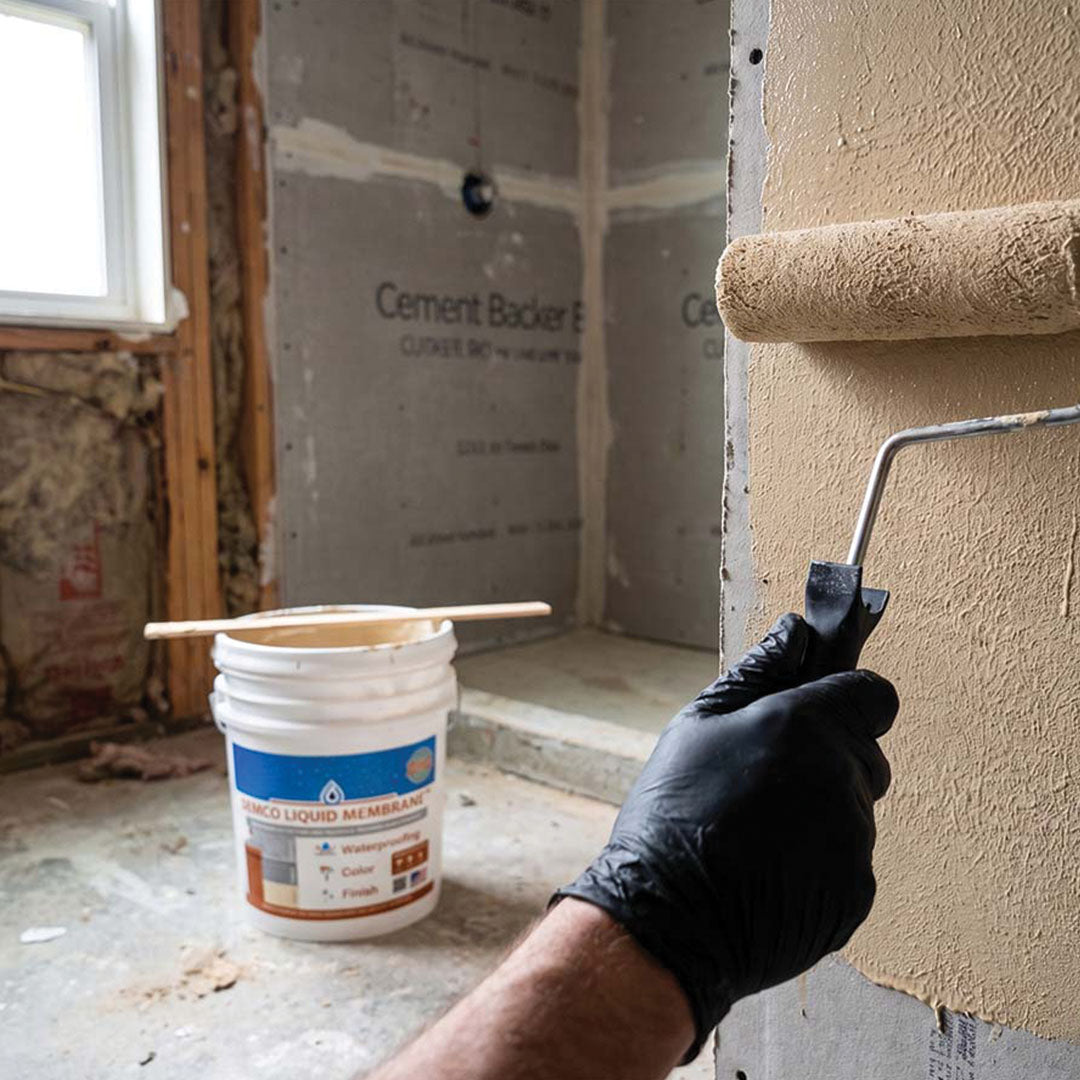
Using a brush or a 1/2 inch nap roller, apply a thin coat, roughly 0.015 inch, over the boards, seams, and framing. Let it dry until you can walk on it without leaving a fingerprint or residue on your shoe, then apply a second coat in the opposite direction. Standard decks need a minimum of 2 coats; roof decks or balconies over living space should get 3 coats, since a leak there means interior damage, not just a wet crawlspace. Total cured thickness should reach 0.03 to 0.04 inches.
Step 4: Let it cure before it sees water or weight
Between coats, expect roughly 1 to 2 hours to dry-to-touch at 70°F and 50% relative humidity. Full initial cure runs about 6 to 7 days depending on temperature, humidity, and airflow. Avoid applying in direct afternoon sun or above 85°F, which can skin the coating over before it fully bonds.

Water-based, single-component membrane that cures into a flexible, 1300% elongation rubber film. About $0.39/sq ft in the 5-gallon pail.
Do You Need Fabric Reinforcement at the Seams and Ledger Board?
If your deck has any cracks, board joints, or the ledger board seam where the deck meets the house, that's exactly where SEMCO Fabric Reinforcement goes. It embeds into a wet coat of Liquid Membrane and adds tensile strength across joints that move the most as the deck expands, contracts, and settles, which is precisely where an unreinforced coating is most likely to crack open again after a season or two.

Embeds into wet Liquid Membrane over seams, joints, and the ledger board to add load-bearing strength where movement is highest.
How Many Coats and How Much Coverage You'll Need
| Deck type | Minimum coats | Cured thickness | Coverage per gallon |
|---|---|---|---|
| Standard ground-level deck | 2 coats | 0.03 to 0.04 in | 200 to 250 sq ft |
| Roof deck or balcony over living space | 3 coats | 0.03 to 0.04 in | 100 to 150 sq ft |
Rough, bare, or older wood soaks up more material, so coverage often lands toward the lower end of that range. Measure your square footage before you buy, plan for every coat, and size up. For most single decks, the 5-gallon pail is the most economical option per square foot.
Sealer/Stain vs. a Waterproofing Membrane
| Factor | Sealer / stain | Liquid waterproofing membrane |
|---|---|---|
| How it protects | Penetrates or sits on the surface to repel water | Cures into a continuous, seamless film across boards and framing |
| Crack bridging | Minimal; not elastomeric | Bridges cracks up to 1/4 in and stretches up to 1300% |
| Ledger board / framing protection | Rarely applied there | Coats framing, joists, and posts directly |
| Reapplication | Every 1 to 3 years | Lasts multiple seasons before recoating |
| Upfront cost | Lower per gallon | Higher upfront, roughly $0.39/sq ft in the 5-gallon size |
They aren't mutually exclusive. A common approach is to waterproof the structural risk points, the framing, ledger board, and seams, with a membrane, then use a stain or sealer topcoat on the visible walking surface for color and UV protection.
Do You Need a Sealer Topcoat for Heavy Traffic?
SEMCO Liquid Membrane is rated for light foot traffic on its own. If your deck sees heavy foot traffic, furniture, or grills that stay in one spot, a topcoat like Titan Shield Gloss adds a harder-wearing surface layer on top of the waterproofing so the membrane underneath isn't taking direct abrasion.

Single-component, water-based polyurethane hybrid sealer for decks with heavy foot traffic or furniture.
When to Waterproof Your Deck Before Fall Rains
Work backward from your first heavy rain or freeze. With a 6 to 7 day initial cure and two coats that each need to dry-to-touch before recoating, plan for a full dry weekend plus a buffer, and avoid days forecast above 85°F or with rain in the cure window. Late summer into early fall, before the wood has taken on a season's worth of rain and before temperatures drop enough to slow curing, is the narrow window that gets this done right. If you're also waterproofing a basement or foundation this season, see our basement waterproofing checklist before fall rains for the same timing logic applied indoors.
Frequently Asked Questions
Do I need to waterproof the underside of a deck, not just the top?
For full protection, yes. Coating only the walking surface leaves the framing and joists, which are structural and sit closer to the ground, unprotected from splashback and ground moisture. Coating the tops, edges, undersides, and framing gives the longest service life; at minimum, fully seal the walking surface and board edges.
Will a waterproofing membrane make my deck slippery?
Liquid Membrane cures to a workable, textured film suitable for light foot traffic. For decks that get wet regularly or see heavy use, a sealer topcoat like Titan Shield Gloss or a non-skid additive can be added on top for extra grip.
Can I apply a deck waterproofing membrane over plywood or OSB?
Yes. It bonds to plywood and wood sheathing, which makes it a fit for balconies and decks built over occupied rooms below. See our full guide to waterproofing plywood for substrate-specific prep.
Why does my deck feel tacky after coating?
A tacky surface usually means the coating hasn't finished curing, was applied too thick, or was applied in cool or humid weather. Give it the full cure window at moderate temperatures with good airflow, and always build up thin coats rather than one thick one.
How long before I can walk on a freshly waterproofed deck?
You can typically walk on it once the final coat is dry-to-touch, roughly 1 to 2 hours at 70°F and 50% relative humidity, but hold off on furniture, planters, or water exposure until the full 6 to 7 day cure is complete.
What should I do first if I haven't prepped my deck yet?
Start with our surface prep guide. Skipping prep is the single most common reason a DIY waterproofing job fails, on decks or anywhere else.
Ready to waterproof your deck before the rain hits?
Start with SEMCO Liquid Membrane, add Fabric Reinforcement at the seams and ledger board, and top it off with Titan Shield Gloss if your deck sees heavy traffic.
Shop Wood Decks & Balcony Kits →Free shipping on orders over $99 to the 48 contiguous states.
Related reading: