
If your metal roof is leaking again after you already sealed it, the coating itself is rarely the real problem. Most repeat metal roof leaks come down to four things: fasteners that back out as the panel expands and contracts with temperature, water pulled sideways into seams by capillary action, sealant or caulk that dries out and cracks under UV exposure, and a coating that was applied too thin to move with the metal. Fix the underlying cause instead of just the spot that's dripping, and a metal roof coating job holds for years instead of one season.

Why Does a Metal Roof Keep Leaking After It's Been Sealed?
Because the first fix usually treats a symptom, not the mechanism. A dab of caulk over a drip stops that one drop for a while, but metal roofing moves more than almost any other roofing material as it heats and cools through the day. That constant expansion and contraction is what loosens fasteners, opens seams, and stresses flashing and sealant over and over, so a spot patch that isn't built to move with the panel is on borrowed time.
What Actually Causes Metal Roof Leaks?
Four mechanisms account for the large majority of metal roof leaks, according to roofing industry sources such as Sheffield Metals' learning center:
- Fastener back-out. Screws loosen as panels repeatedly expand and contract, and the rubber washers under them harden and crack from years of heat and UV exposure, opening a path for water at every one of those hundreds of screw points.
- Capillary action at seams. Wind-driven rain can be pulled sideways into the tight overlap between panels even when there's no visible gap, especially where the original seam sealant has thinned or the panels were never seated tightly.
- Flashing and sealant degradation. The sealant around vents, skylights, chimneys, and roof edges breaks down faster than the metal itself, since it takes the brunt of UV exposure and thermal stress.
- Thermal movement stress. If the coating or sealant system wasn't built to flex with the roof, the constant cycling eventually cracks it right at the joints, fasteners, and panel ends where the movement is greatest.

Myth: Any Waterproof Coating Will Stop the Leak
Not quite. What actually stops a leak for good is a coating with enough film thickness and enough elongation to keep moving with the metal instead of cracking at the first seam or fastener under stress. A coat that's applied too thin, or a compound that goes rigid once fully cured, can look fine on day one and open right back up after a season of temperature swings.
Different compound categories behave differently here. Our full side-by-side comparison of water-based, silicone-based, and rubber-based roof coatings breaks down odor, cure time, and flexibility in detail, but the short version is in the table below.

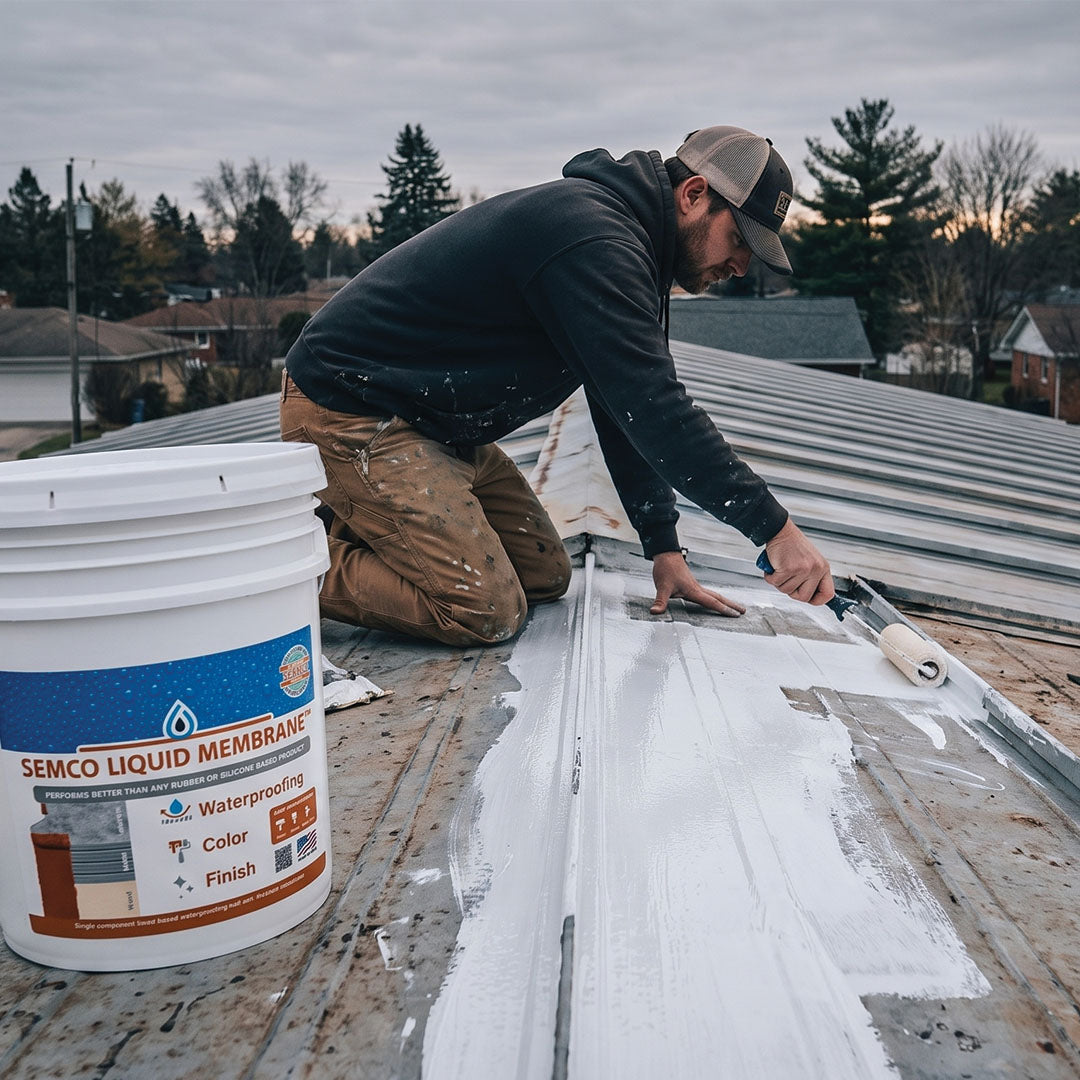
Single-component, water-based membrane with 234 PSI adhesion and 1300% elongation, so it moves with a metal roof instead of cracking at the seams.
How Do You Actually Fix a Metal Roof Leak for Good?
Treat the cause, not just the drip. That means tightening or replacing backed-out fasteners before you coat anything, reinforcing every seam, vent, and flashing point with a fabric strip so those joints can flex without cracking, and applying the coating at a real, measured thickness rather than a thin cosmetic layer. We've already put together a full walkthrough of that entire process, from finding the source of a leak to applying the coat correctly, in How to Find and Fix a Leak in a Metal Roof, so use this piece for the why and that one for the exact steps.

Embed this fabric strip in wet Liquid Membrane over every seam, fastener line, and flashing point so those spots can flex instead of cracking open again.
Water-Based Membrane vs Silicone-Based and Rubber-Based Roof Coatings
Here's a general comparison of how the three common roof coating compound types behave. Always check the specific product's data sheet, since formulations vary between manufacturers.
| Compound type | Odor during cure | Typical cure time | Flexibility | Common failure mode |
|---|---|---|---|---|
| Water-based liquid membrane | Low, minimal solvent smell | Recoat in hours; full cure over a few days | High elongation, built to move with thermal cycling | Under-thickness application if rushed |
| Silicone-based (ceramic-fortified) coating | Mild; cures via moisture in the air | Longer tack-free time in low humidity | Strong UV resistance, can be less elastic once fully cured | Cracking if applied thin over active movement joints |
| Rubber-based (asphalt/polymer) coating | Noticeable solvent or asphalt odor during cure | Varies by formulation, often a longer full cure | Generally flexible, can soften in extreme heat | Old rubberized patches peeling where new coat won't bond |
Frequently Asked Questions
How long does a metal roof coating actually last?
A properly applied liquid membrane at the recommended 30 to 40 mil thickness, over sound fasteners and reinforced seams, is built to last for years rather than a single season, since it's designed to move with the roof instead of just sitting on top of it.
Can I recoat over old sealant or a previous rubber patch?
You need a clean, sound surface first. Loose, peeling, or crumbling old sealant or patches should be scraped away and the area cleaned, since a new coating can't bond well over material that's already failing.
What's the minimum coating thickness to actually stop a leak?
For SEMCO Liquid Membrane on a metal roof, that's a total of 30 to 40 mil thickness across multiple coats, letting each coat dry before adding the next.
Do I need fabric reinforcement on every seam?
Any seam, fastener line, vent, or flashing point that flexes or has a gap benefits from a fabric strip embedded in wet membrane, since it lets that joint move without cracking the coating above it.
Is a water-based membrane strong enough for a full metal roof?
Yes. SEMCO Liquid Membrane carries 234 PSI adhesion strength and 1300% elongation, and it's rated for full metal roof application, not just spot repairs.
Stop Patching the Symptom. Coat the Whole Roof Once, Right.
SEMCO Liquid Membrane is a single-component, water-based membrane made in the USA, with 234 PSI adhesion and 1300% elongation built in.
Shop SEMCO Liquid Membrane →Related reading: