



★★★★★ Rated 4.8 by 1,000+ homeowners
Your basement isn't leaking through a crack — it's sweating through the whole wall.
If the damp keeps coming back after you've painted, sealed and run a dehumidifier, you've been treating the surface. The water isn't getting past your wall. It's coming straight through it.


Untreated CMU block · water moving through the pores
Sound familiar?
Six signs the water is already inside your wall.
Most homeowners assume it's a one-off — a bad storm, a blocked gutter, a hairline crack. But if it keeps returning, these signs share one cause, and it isn't the crack you can see.
- A musty smell that returns every time it rains — even with the dehumidifier running
- White chalky powder on the block or concreteThat's efflorescence — minerals left behind by water that has already passed through.
- Dark damp patches low on the wall that dry out, then come back
- Paint or sealer bubbling and flaking off in sheets
- Boxes, drywall or carpet that smell before they look wet
- You've sealed it once already — and it held for exactly one season
Any one of these alone might be nothing. Together, on repeat, they mean groundwater is moving through the wall itself — and no amount of surface paint will stop that.
The root cause
What's actually happening behind your basement wall.
Your basement sits below the water table for part of every year. When it rains, the soil around your foundation saturates and water pushes inward against the wall. That force is hydrostatic pressure, and it doesn't need a crack to get in.
Concrete and CMU block look solid but are full of microscopic pores. Water is pushed through them, and rises up through the slab by capillary action. By the time you see a damp patch, water has already travelled the full thickness of the wall.
The wall isn't a barrier. Untreated, it's a sponge under pressure.
Two things then break every surface fix. First, the pressure comes from behind the coating, so anything sitting on top gets pushed off from the back — that's why sealer paint bubbles and peels. Second, foundations move: they settle, they expand and contract. A rigid coating has effectively zero stretch, so the moment the wall shifts, the coating splits and the water finds the split.
To stop it from the inside you need two things at once: a film that bonds hard enough to resist being pushed off, and flexible enough to move with the wall instead of cracking with it.
The honest part
Why everything you've tried only bought you time.
You've probably paid for at least two of these. Here's the mechanical reason each one gives out.
Masonry waterproof paint
Rigid — can't move
A paint formulated for masonry, with essentially no stretch. It can't bridge a hairline crack, and under hydrostatic pressure it gets pushed off the wall from behind. Its own reviews are full of coatings that didn't survive the first heavy rain.
A dehumidifier
Treats air, not wall
It pulls moisture out of the room after the water is already inside. Useful alongside a fix. Useless as one — and it runs on your electricity bill forever.
Hydraulic cement patching
Fixes one spot
Plugs the crack you found. The water moves through the pores either side of the patch, or through the next crack that opens as the foundation settles.
A contractor quote
Thousands, and days of mess
Interior drainage systems and sump installs run into the thousands, take days, and often mean breaking up your slab — for a problem you can frequently coat yourself in a weekend.
Every one of these either sits on the problem or works around it. The fix is a bonded, flexible membrane on the wall itself.
The inside-out fix
Waterproofing that moves with your foundation.
SEMCO Liquid Membrane isn't a paint. It's a liquid-applied rubber membrane that cures into one seamless, flexible sheet bonded directly to your wall — sealing the pores the water is coming through.
Stops water at the wall
Forms a continuous, seamless film across block, concrete and mortar joints alike. Rated for negative-side (interior) application, so you don't have to excavate outside to fix it from within.
Stretches instead of cracking
Up to 1,300% elongation (ASTM D412). It bridges hairline cracks up to ¼" and keeps its seal as the foundation settles and shifts through the seasons.
Safe to use in a closed basement
Water-based and VOC-free at 14 g/L. Low odor, no solvent fumes, no need to ventilate a space that often has one small window.
Roll it on like paint
Single component, straight from the bucket. No mixing, no catalyst, no special tools. A ½" nap roller, two coats, and warm water to clean up.

The numbers
Every claim here has a test behind it.
Published test data, not adjectives. Full technical data sheet linked on the product page.
Stretches thirteen times its own length before failing. That's what lets it bridge a crack a rigid coating would split across.
173 PSI at 7 days, building to 234 PSI at four weeks (ANSI 118.10). Pressure pushing outward has to beat that bond to lift the film.
Effectively odorless and non-toxic once cured — safe for enclosed, poorly ventilated spaces.
Two coats at 15 mil each builds a genuine membrane, not a stain. Coverage runs 100–250 sq ft per gallon depending on how porous your wall is.
Tested water vapor permeability. It blocks liquid water while still passing vapor, so the wall isn't sealed into a moisture trap — the failure mode that ruins impermeable coatings on below-grade block.
Certified as a primary waterproofing layer under the German and EU standard for liquid-applied water-impermeable products — not a supplementary coating, but the waterproofing itself.
Five-year standard limited warranty; ten years on non-traffic surfaces, which includes basement walls.
A 4.8 average across more than a thousand published customer reviews.
A weekend, not a renovation
Four steps. Waterproofing that works.
If you can roll paint, you can do this. The only part that needs discipline is the prep.
Get the wall clean and dry
Remove loose paint and debris. Clear efflorescence and mineral deposits with Nu-Lift Cleaner and Stone Soap, then let the wall dry fully.
Bridge anything over ¼"
Coat the crack, press in Fabric Reinforcement, coat over it to encapsulate. Hairline cracks need nothing — the membrane spans those on its own.
Roll two coats
½" nap roller, thin and even, roughly 15 mil per coat. Recoat in 25–45 minutes at 72°F, running the second coat perpendicular to the first. Both go on the same day.
Let it cure
Dry to touch in about an hour. Initial cure is 6–7 days. Keep water off it during that window.
The wall must be dry before you startLiquid Membrane can't be applied over damp substrate — residual moisture must be under 3%, or the coating traps it and stays tacky instead of curing. If your wall is constantly damp, apply Natural Shield first and let it fully cure before the membrane goes on. Apply between 50–90°F.
Real basements
Homeowners who stopped chasing it.
Selected from 149 basement reviews of SEMCO Liquid Membrane. Every one verified, unedited except for length.
"We still had wet walls."
"I used this on two of our basement walls. They were always damp and I had a serious mold problem. We had professionals put in drains along the walls leading to a sump pump, which would be a help if we had puddling water but we still had wet walls. I searched on the internet and found this product. It is so easy to use and I was really happy to find it in white. It is really helping me eliminate the mold problem in my basement."
"I tried some other products, which didn't work."
"This product does the job. Period. I noticed water seepage in my basement after heavy rain. I tried some other products, which didn't work. This was easy to apply and has stopped the leaks. I highly recommend this product and will purchase again if needed."
"I was shocked with a $40k estimate."
"I noticed some degradation on my concrete foundation so I contacted a company specializing in foundation repair. I was shocked with a $40k estimate… for the garage alone. I sought a second and third opinion. Some minor repair work and concrete sealer was all needed. I decided that this a DIY job so I did some extensive internet searching for the correct products. That's when I found SEMCO. I purchased the Stone Soap, Nu-Lift cleaner and Liquid Membrane. Easy to apply and looks good. I couldn't be happier."
"Haven't had a drop of water in my basement."
"Very satisfied with SEMCO Liquid Membrane. It's been two months and despite the wettest winter I've seen, I haven't had a drop of water in my basement and was able to apply carpet over my floor without having to fear water damage seeping in. This stuff really works."
"I didn't have to worry about ventilation."
"I used something like this before. I hate its smell! However, this liquid membrane is different. I used it on my crawl space and I didn't have to worry about ventilation."
"One gallon completely covered 20' x 9'."
"We bought this for our basement to protect the blocks from humidity. It's super easy to use and dries quickly. Good thickness. And the value for the money was great compared to Lowe's and Home Depot where we normally purchase all of our home repair supplies. One gallon completely covered an area of about 20' x 9' and we had some left over."
"One of the best products on the marketplace."
"Considering the cost, the actual high quality of the product and the relative ease of application to exterior and interior walls, I believe this to be one of the best products on the marketplace. I am a retired licensed civil and mechanical engineer in my late 60s, so I know and appreciate a good quality product when I see and use one."
"Multiple coats in one day."
"I used this to waterproof the inside of a cinder block retaining wall. It was so easy to apply. I used a roller with 1/2 nap and a cheap masonry brush for the corners. In 50 degree F it dried to the touch in about 2–3 hours so I was able to apply multiple coats in one day. Water cleanup of the brush was easy. Highly recommend."
"The dampness is gone."
"I used it to cover basement walls that would get damp every time it rained. After a few months, the dampness is gone."
"It has no smell and dried quickly."
"I liked that I was able to contact customer support through the chat feature on the website. They assisted me on what product is suitable for my basement floor. I used SEMCO Liquid Membrane, it has no smell and dried quickly. I also used Fabric Reinforcement on the corners of my basement, it blended in with the liquid membrane."
"It helped me cover the cracks in my walls."
"I was searching online for what product would be suitable for my basement walls. Glad I found this product — it helped me to cover the cracks that can be found in my walls. One of the things I also love is it doesn't have any strong smell."
"Saved me from needing outside assistance."
"This product has saved me from needing outside assistance with the leak in my basement. 100% recommend this product."


SEMCO Liquid Membrane™
A ready-to-use waterproofing and anti-fracture membrane. Coat, color and seal in one product — rolled straight onto your basement wall.
Coverage shown at 2 coats on porous block. Smooth poured concrete goes further.
Selected: White
All 14 colors are the same price. White is the default for basements — it brightens a dark room, and it makes missed spots easy to see while the coat is still wet.
Before / after
Block walls that stopped leaking.
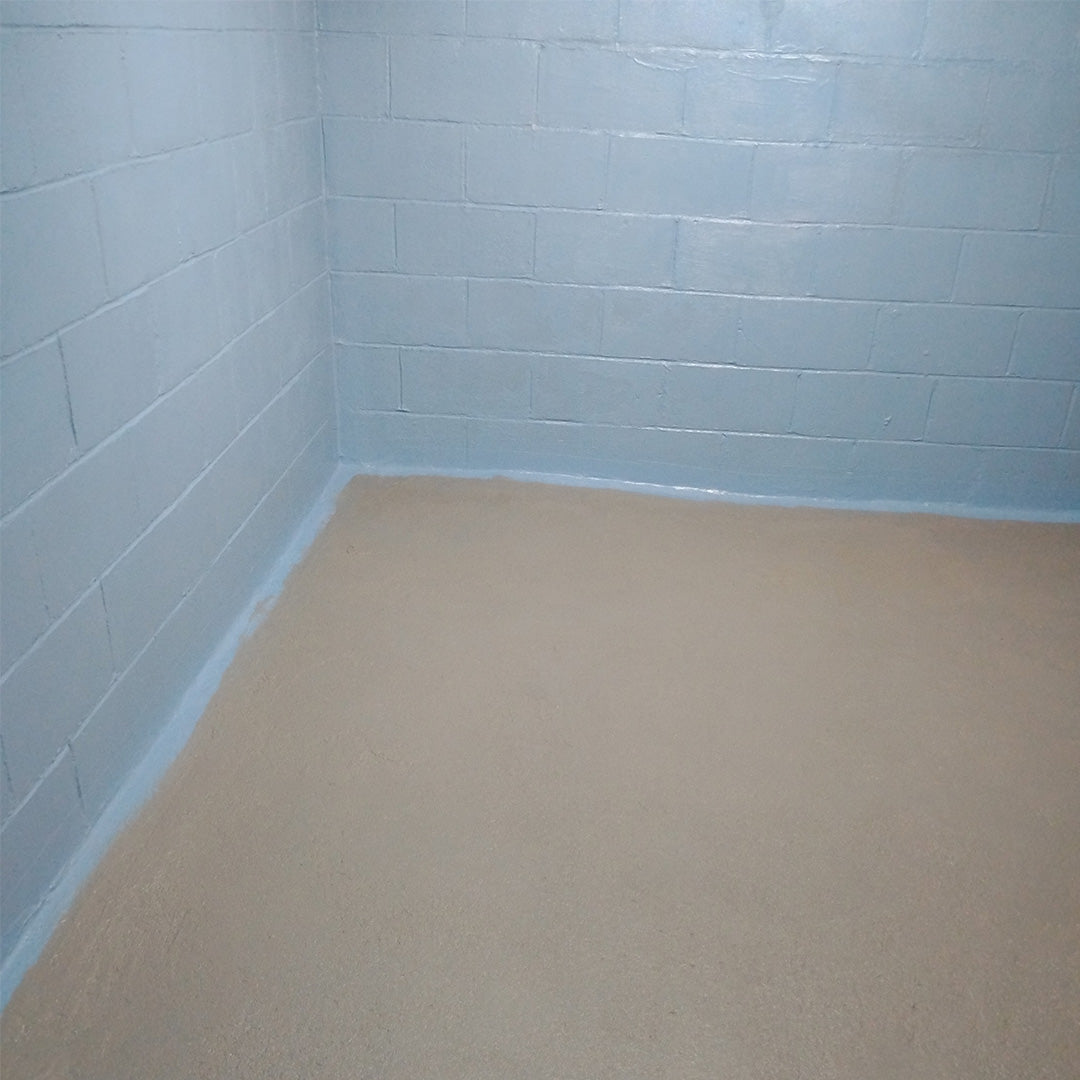
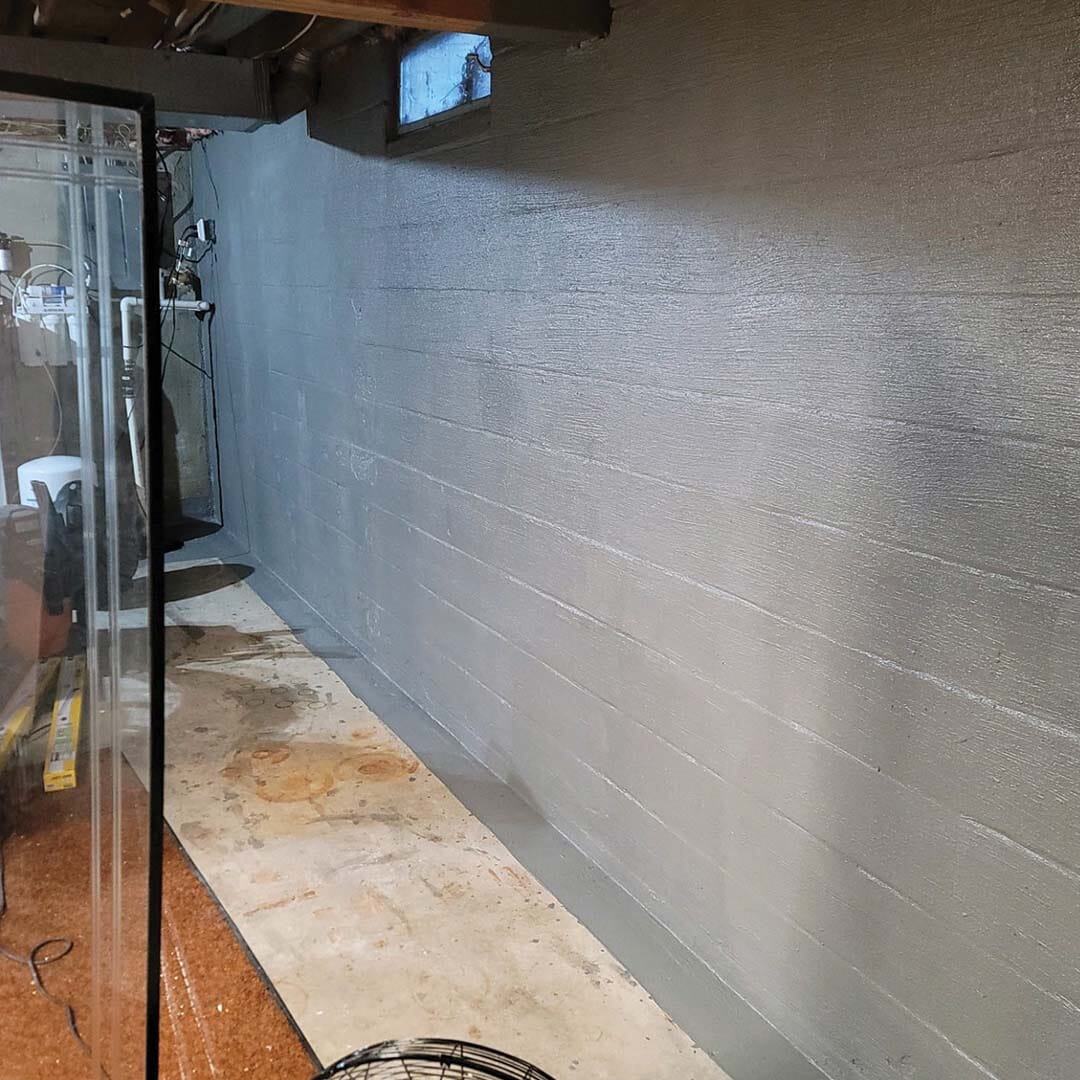
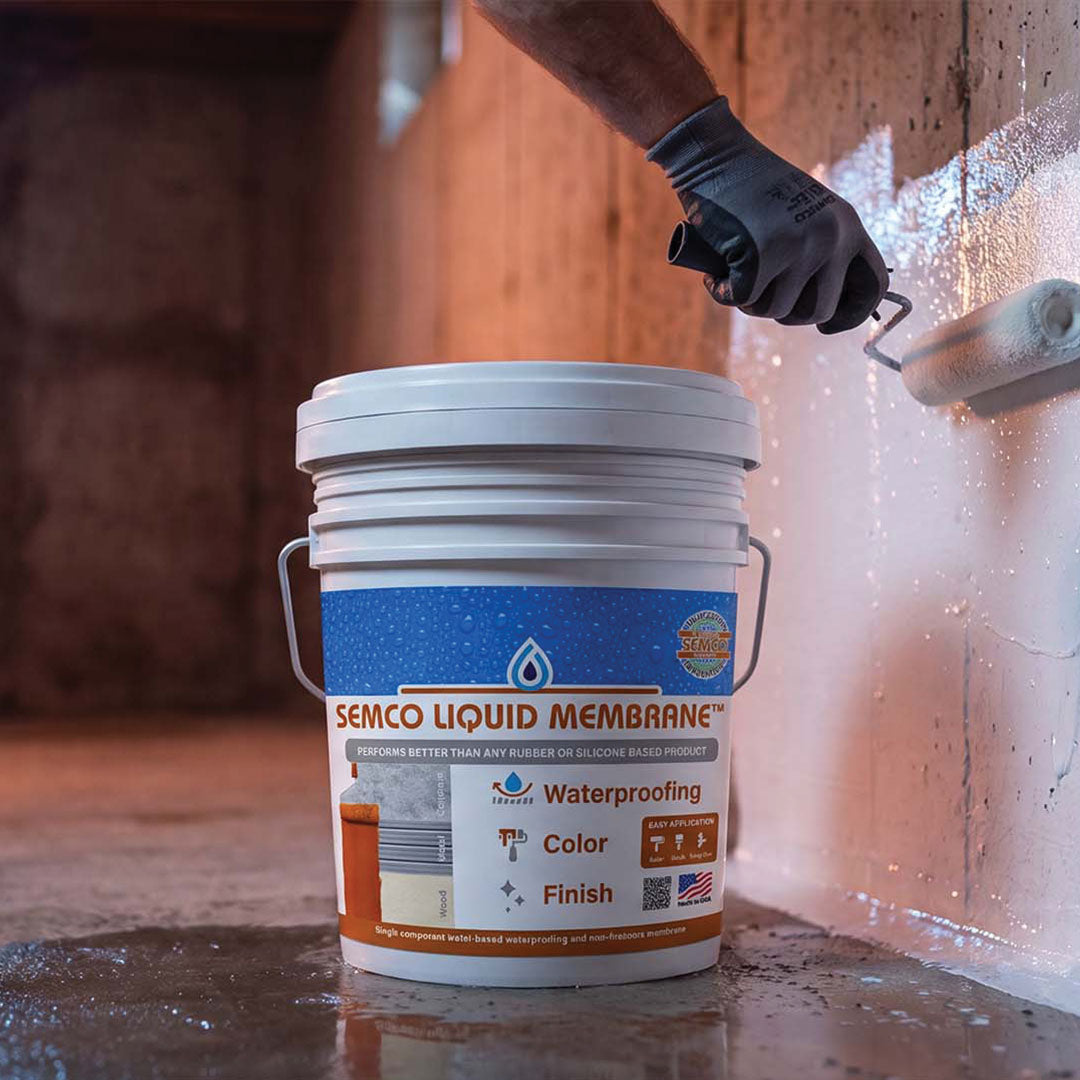
Swap any of these for customer phone video as it comes in — it outperforms studio footage on this section.
Backed in writing
Five years. Ten on walls.
Applied to a properly prepared surface, SEMCO Liquid Membrane carries a 5-year standard limited warranty — extended to 10 years on non-traffic surfaces, which includes basement walls. It's been used on basements, pools and flat roofs across thousands of installations, by a company that's been engineering surfaces since 1991.
Before you buy
The questions worth asking.
Will this work if water is actively coming in?
It's rated for negative-side application, so it stops water pushing through the wall from outside. What it can't do is fix a structural failure or an active flowing leak — those need repair first. If you have standing water or a crack wider than ¼", handle that, then coat.
My wall is damp right now. Can I apply it?
No, and this is the one rule that matters most. The substrate has to be under 3% residual moisture or the coating traps it and stays tacky instead of curing. Dry the wall out first. If it never fully dries, apply Natural Shield, let it cure, then apply the membrane.
How much do I need?
Plan on 100–250 sq ft per gallon for two coats, depending on how porous your wall is. Block absorbs more than smooth poured concrete. Use the calculator above — and if you're between sizes, size up. A full second coat is what makes the membrane work.
Can I paint over it?
Yes, once fully cured. But you may not want to: it comes in 15 colors with the color built into the waterproofing coat, so most people skip the extra step.
Will it smell up the house?
It's water-based and VOC-free at 14 g/L. There's a faint smell while wet and effectively none once cured. Safe for a basement with one small window.
How is this different from waterproofing paint?
Masonry paint is rigid and sits on the surface. This cures into a flexible bonded rubber membrane that stretches up to 1,300% — so when your foundation moves, the seal moves with it rather than splitting.
What if I've already painted the wall?
Remove anything loose or flaking. The membrane needs to bond to sound substrate. If the old coating is solid and well-adhered, test a small patch first.
How long before I can put the room back together?
Dry to touch in about an hour, initial cure 6–7 days. Keep water off it during cure.
Still not sure? Call 1-833-211-2297 — the team knows these projects and will tell you honestly if this isn't your fix.
One productTwo coatsOne weekendA dry basement
Stop treating the symptom. Seal the wall.
Musty smell? Chalky white residue? Paint that keeps peeling? The water is coming through the wall — seal it where it enters.
